
It is the question parents put to us more often than almost any other. A family is moving, or a pupil has arrived from Moscow mid-year, or a bright Year 10 student wants to know whether Russian teenagers have it easier. The honest answer is that the two systems rhyme rather more than you'd expect — and then diverge on one point so sharply that it changes the whole feel of being seventeen in Russia.
Here's the plain version, without the jargon.
The shape of the school itself
Russian pupils can remain in the same school from Grade 1 to Grade 11, although this is not universal. Individual schools may offer the primary, lower-secondary and upper-secondary programmes in any combination, so a pupil may well change school between stages. But where one school covers the whole span — and many do — a child genuinely starts in первый класс and leaves from одиннадцатый класс in the same building, often with some of the same teachers and very often with the same classmates. There's no built-in primary-to-secondary transfer at eleven of the kind British children go through, and that does something to the social texture of a Russian year group that's quite unlike a British one.
The stages break down as follows:
- Начальная школа (primary), Grades 1–4. Grade 1 normally begins between the ages of six and a half and eight, so a Russian first-year pupil is typically older than an English Reception child.
- Основная школа (lower secondary), Grades 5–9 — the core years, ending at about fifteen.
- Старшая школа (upper secondary), Grades 10–11 — the direct analogue of sixth form, ending at about seventeen or eighteen.
Here's the point that trips up almost every British write-up of the Russian system: compulsory education does not stop after Grade 9. Secondary general education remains compulsory until the age of eighteen, unless the pupil obtains it sooner. What changes at fifteen is the route, and that decision will feel very familiar to any British parent: stay on for Grades 10 and 11 at school, or move to a колледж or техникум — where secondary general education is built into the vocational programme rather than abandoned. Plenty choose the latter, and a trade or technical qualification is a perfectly respectable route, not a consolation prize.
The OGE: Russia's GCSE moment
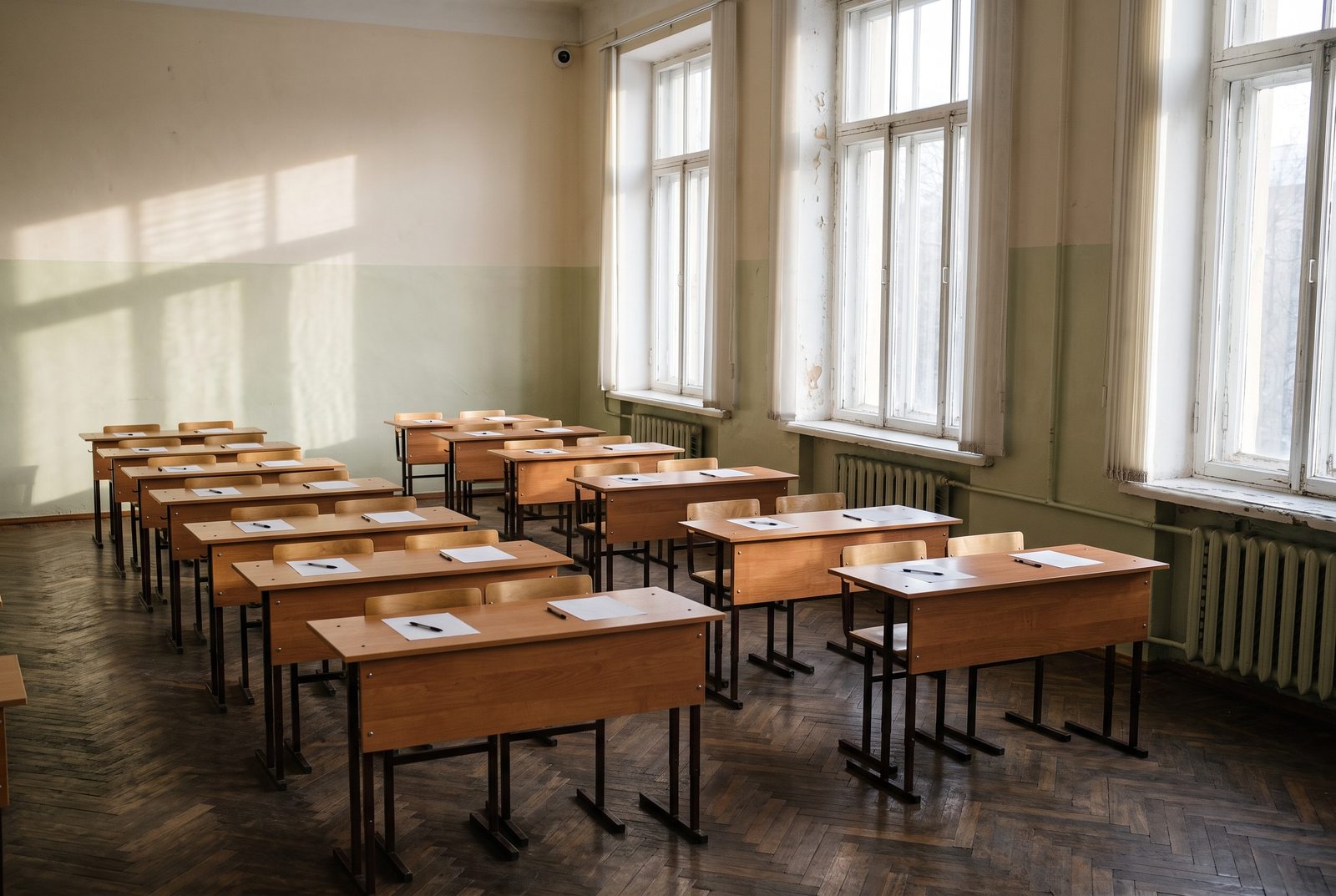
At the end of Grade 9, pupils sit the ОГЭ — the Основной государственный экзамен, or Basic State Exam. In structure it's the closest thing Russia has to GCSEs, and it lands at exactly the same age.
The difference is scale. Where a British pupil might sit nine or ten GCSEs, the OGE under the standard system consists of four subjects: Russian language and mathematics, which are compulsory, plus two subjects of the pupil's choosing. That's it — less than half as many nationally examined subjects as a British fifteen-year-old faces. The broad compulsory curriculum is still there; it's simply assessed internally rather than nationally. (Worth noting for 2026: a pilot running in twelve regions lets certain pupils heading into vocational education sit only Russian and mathematics.)
Passing the OGE earns a certificate of basic general education and, in broad terms, the right to continue into Grades 10 and 11. It is not, however, an automatic ticket into a particular school or a selective academic profile — regional rules can allow schools to select for specialised Grade 10 programmes. Even so, the OGE is a gateway rather than a currency: nobody will ask about your OGE results in ten years' time.
The EGE: where the systems genuinely part company
Two years later comes the ЕГЭ — the Единый государственный экзамен, or Unified State Exam. This is the one that matters, and it works quite differently from A-levels.
An A-level result does two jobs loosely: it certifies what you learned, and it feeds into a wider judgement. Universities consider qualifications alongside the UCAS application and reference; some courses or institutions also use interviews or admissions tests. (For 2026 entry onwards the UCAS personal statement is structured around three set questions, though it's still called a personal statement.) The EGE does both jobs at once and almost exclusively. Since 2009 it has served as both the school leaving examination and the national university entrance examination. Your EGE scores, in the main, are your application.
Russian language and mathematics are compulsory for the school leaving certificate — though mathematics can be taken at basic or profile level, and maths doesn't necessarily count towards a university applicant's subject total; that depends entirely on the course. Beyond the compulsory pair, pupils choose according to the degree they're chasing: physics for engineering, biology and chemistry for medicine, social studies for law and economics, a foreign language for linguistics. Those choices are formally registered by 1 February of the examination year, usually while the pupil is in Grade 11 — so it isn't an irrevocable decision made at sixteen, but it does need to line up with the faculty's stated requirements well before results day.
Most EGE subjects, profile mathematics included, are marked out of 100. Basic mathematics is the exception: it's marked on the familiar five-point scale and isn't used as a university entrance score at all. Here's the part British families find most striking — applicants effectively total their scores across the required subjects and universities admit in descending order until the places run out. A candidate with 280 out of a possible 300 across three subjects is in a very different position from one with 250, and the thresholds at the most competitive Moscow and St Petersburg faculties are brutally high. Admission is overwhelmingly score-driven, and there's no close equivalent of UCAS Clearing. That said, it isn't purely mechanical: some universities and subjects set additional academic, creative, professional or physical aptitude tests, and there is a further round of admissions for places left unfilled.
Nor is a bad morning necessarily fatal. Reserve sitting dates exist for pupils who miss a paper for a legitimate reason, and school-leavers may retake one chosen EGE subject on designated summer dates — in 2026 those fell on 8 and 9 July, with around 149,000 candidates signing up. It's one subject, not the whole set, so the pressure is real. But the popular British image of a single unrepeatable examination day isn't quite right either.
| England | Russia | |
|---|---|---|
| Exam at 15–16 | GCSEs — typically 9–10 subjects | OGE — 4 subjects (2 compulsory) |
| Exam at 17–18 | A-levels — usually 3 subjects | EGE — Russian, maths + chosen subjects |
| Grading | Letters/numbers per subject | 0–100 points per subject (basic maths on the five-point scale) |
| University entry | Grades plus the UCAS application and reference; some courses add interviews or tests | EGE score total, ranked competitively; some courses add extra tests |
| Compulsory until | 18 (education or training) | 18, or until secondary general education is obtained |
| School day | Roughly 8.45am–3.30pm | Often 8am–2pm, sometimes in shifts |
Marks out of five, not letters
Day to day, Russian schools don't use A to G or 9 to 1. They use a five-point scale, and it's worth knowing because it comes up constantly in conversation:
- 5 — отлично (excellent). The one everyone wants.
- 4 — хорошо (good). Perfectly respectable.
- 3 — удовлетворительно (satisfactory). Colloquially a тройка, and mildly disappointing.
- 2 — неудовлетворительно (unsatisfactory). A fail.
- 1 — technically exists, practically never awarded.
Straight fives are the route to a золотая медаль — the gold-coloured first-degree medal — but the bar is higher than "nothing but fives". Under the current rules a pupil normally needs all final grades at five and at least 70 marks in Russian plus 70 in another EGE subject, with alternative arrangements for candidates taking basic mathematics or the GVE. There's a second-degree, silver-coloured medal as well. Either carries genuine prestige and a small advantage in admissions. And a pupil described as an отличник is the Russian equivalent of a straight-A student, with all the affection and mild teasing that implies.
1st September: Knowledge Day
Now the part every British learner ought to understand, because it tells you something real about how Russians feel about school.
The Russian academic year begins on 1 September — День знаний, Knowledge Day — and it begins with a ceremony, not a timetable. Pupils arrive in their smartest clothes. Large white hair bows are traditional, particularly among younger girls and those taking part in the ceremony, though by no means every girl wears them. Many pupils bring flowers for their teachers, and gladioli feature heavily for the very unromantic reason that they're what's blooming in Russian gardens at the end of August.
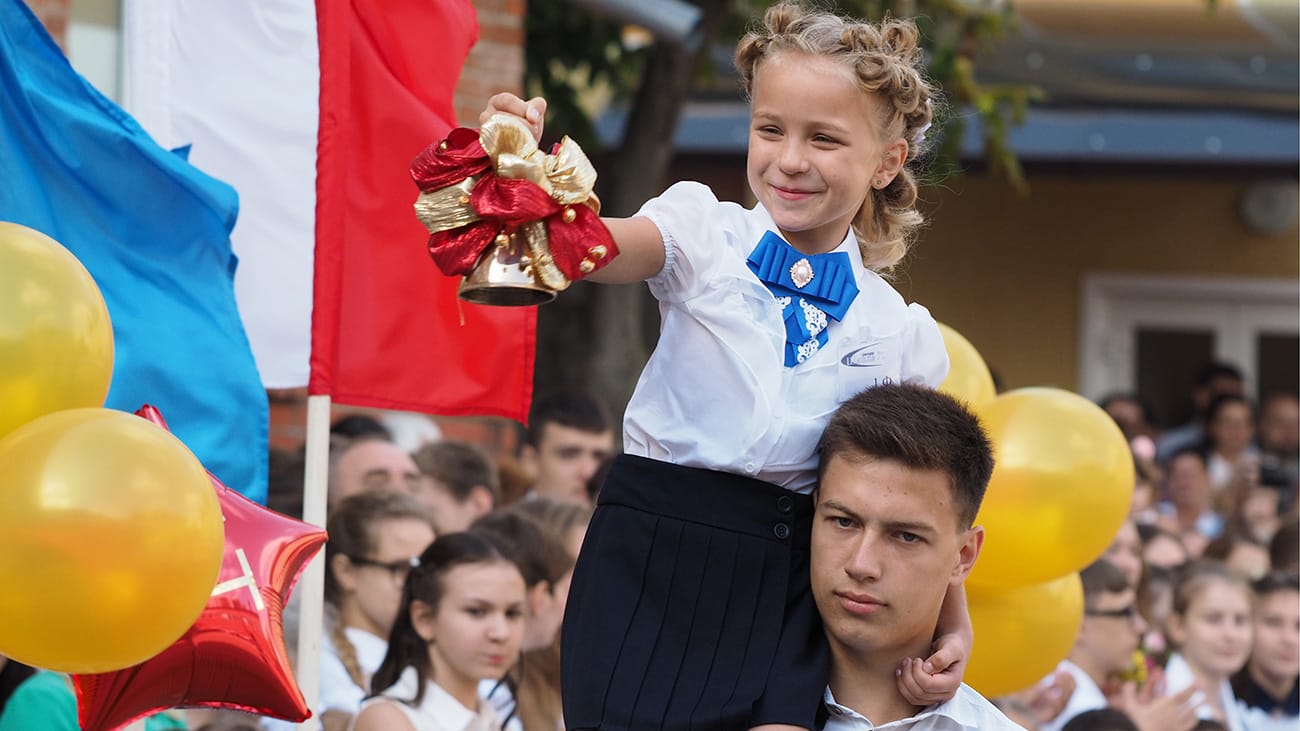
The whole school assembles in the yard. There are speeches, which are usually too long. And then comes the первый звонок — the first bell — commonly rung by a first-year pupil, sometimes perched on the shoulders of a final-year student about to begin their own last year of school. The symbolism is not subtle and nobody minds.
At the end of Grade 11 comes the mirror image: последний звонок, the last bell, held in late May before the EGE season. Some school-leavers dress in Soviet-style school uniform as a bit of affectionate theatre, sashes are worn, and a great many photographs are taken.
Of all the differences between the two systems, this is the one worth pointing to first. A British school year generally begins with registration and a new timetable rather than a nationwide ceremony. The Russian one starts with an assembly, a bell and an armful of flowers. Neither is better. But if you're learning Russian and you want to understand why a phrase like первый звонок makes a Russian adult go slightly misty, that's why.
What this means if you're learning Russian
Three practical things.
The vocabulary is high-value. Школа, класс, урок, экзамен, оценка — this is bread-and-butter language that appears in every textbook, every exam paper and every conversation with a Russian family. Learning it properly early pays off for years.
It's superb speaking-exam material. Comparing education systems is a set-piece topic at GCSE and A-level. A pupil who can say something genuine and specific about the EGE — rather than reciting a memorised paragraph about their own timetable — stands out immediately to an examiner.
It builds cultural footing. Russian conversation is full of shared school references. Knowing what an отличник is, or why a тройка is a slightly sheepish admission, moves you from decoding sentences to actually understanding people.
That last one is the whole point, really. Grammar gets you through the paper. Culture gets you through the conversation.
Sources & further reading
Russian rules on schooling and admissions change more often than you'd think, so this article is checked against primary sources rather than summaries.
- Federal Law No. 273-FZ “On Education in the Russian Federation” — school stages (Art. 23), compulsory education and vocational routes (Arts. 66, 68), admission to school (Art. 67), university admissions (Art. 70)
- Rosobrnadzor — EGE resit arrangements and the marking scales for basic and profile mathematics
- State Duma — the 2026 twelve-region OGE pilot for pupils entering vocational education
- UCAS — the three-question personal statement format for 2026 entry onwards
- GOV.UK — English national curriculum key stages and year-group ages
Last fact-checked: August 2026. Spotted something out of date? Do tell us.
Want to learn real conversational Russian?
Book a private tuition session with Marina — a native speaker with 25+ years' experience, from absolute beginners to GCSE, A-level and degree-level students.
Book a Private Session with MarinaOnline via Zoom, Teams or Google Meet · Face-to-face in Bromley