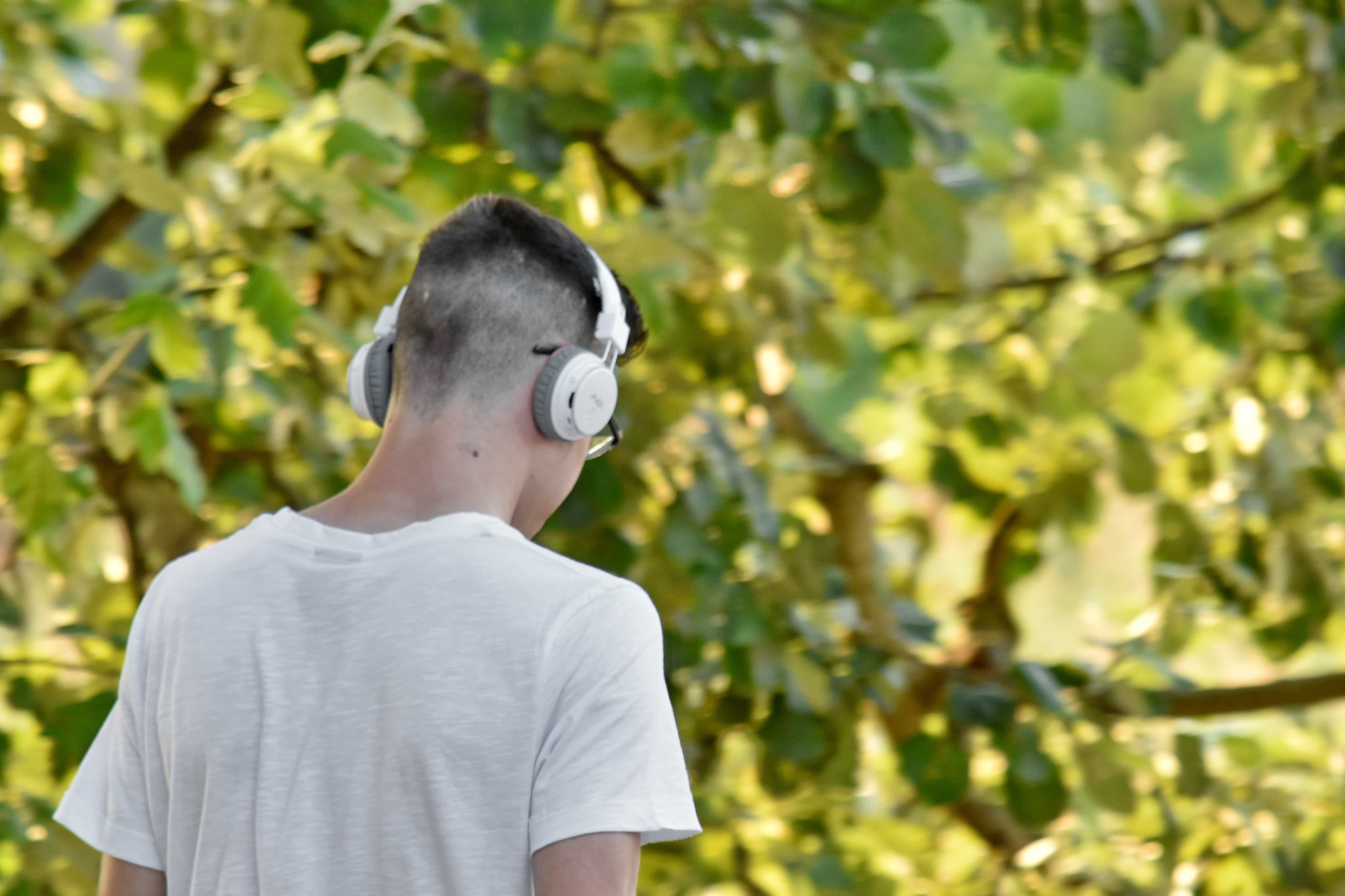
Music earns its place in a Russian lesson, and the reason is worth stating bluntly: a textbook dialogue is written for a learner. A song is written for a native-speaking audience — which is precisely why it offers a different kind of listening practice. Real Russian is fast, elided and full of shortcuts, and a three-minute pop track will teach a student a good deal about how the language actually lands in the ear that a page of scripted conversation never can.
So — what are Russian teenagers actually listening to? Not Tchaikovsky, and not the folk songs that fill the "Russian culture" section of most course books. Here's the honest picture.
Dora — the poet laureate of being seventeen
If you learn one contemporary Russian artist, make it Дора (Dora). Born Daria Shikhanova in Saratov in 1999, she arrived with a sound she cheerfully labelled кьют-рок — "cute-rock" — which tells you most of what you need to know: jangly guitars, a small bright voice, and lyrics about crushes, anxiety and not quite fitting in.
Her breakthrough was Дорадура, created with the producer and rapper Vladimir Galat and released on her 2019 debut album. Dora initially thought the idea sounded too silly for a serious artist; it became the song that established her nationally. But the track to hand a learner is Втюрилась — released as a single in August 2020, on the album that December, with the video following in January 2021. The title alone is worth a lesson: втюриться is exactly the sort of colloquial verb no textbook prints, sitting somewhere between "to have a crush" and "to be smitten". It's a widely understood colloquial verb — marked in dictionaries as informal and slightly lower-register — and altogether more playful than the neutral влюбиться, "to fall in love". You will not find it in a GCSE vocabulary list. She also recorded the song in Italian as Innamorata for the Italian-styled New Year programme Ciao, 2020!, which gives a learner an unusually direct comparison to work with.
Her four studio albums to date — Младшая сестра (2019), the knowingly titled Боже, храни кьют-рок (2020, "God Save Cute-Rock"), Miss (2022) and Lovesongs (2024) — are diaristic and unusually clearly enunciated, and she has kept releasing singles since. She studied the history of Ancient Greece and Rome at the Russian State University for the Humanities, leaving in her second year to concentrate on music.
One honest caveat, because it matters if you're choosing music for a teenager. Dora is not the artist dominating every Russian playlist in 2026. Recent listening data puts rap and hip-hop well ahead among older teens, and VK Music's own 2025 year-end round-up was headed by Macan, Anna Asti and Miyagi & Эндшпиль. Dora is here for a different reason: her combination of colloquial vocabulary, memorable choruses and relatively clear delivery makes her unusually useful to a learner. For a student at intermediate level, she remains the sensible starting point — which is not the same as being the sound of the moment.
The polished chart end
At the glossier end of the same scene sits mainstream radio pop: big hooks, clean production, and choruses engineered to be sung by a crowd. Musically it serves a different purpose from Dora. The vocabulary is simpler and far more repetitive, which makes it useful for rhythm and stress work. Play a chorus a few times and a student starts to feel where the stresses fall without being told.
One practical word for parents and teachers, and it applies to chart music in any language. Plenty of Russian pop and rather more Russian rap carries strong language, and streaming platforms flag it inconsistently. Before a track goes on a playlist for a younger learner, it is worth reading the lyrics through once. Russian swearing — мат — is its own well-developed corner of the language, and while a student will meet it eventually, most parents would rather it wasn't in a homework exercise. Two minutes with the lyric sheet saves an awkward conversation.
One piece of vocabulary from this end of the charts is too good to leave out. Klava Koka's 2026 title Дружить в губы translates literally as "to be friends on the lips" — the joke being that calling something friendship while you're kissing makes it markedly less platonic. There's no clean English equivalent, which is precisely why it sticks.

The wider scene, in brief
Beyond those two, the landscape a Russian teenager moves through looks roughly like this:
- Russian-language rap and hip-hop remains the dominant force among older teens. Dense, fast, heavily slang-laden — brilliant for advanced learners, frustrating for beginners, and worth approaching with the lyrics on screen.
- Indie and bedroom pop has flourished, largely because a laptop and a following on VK can now build a career without a label's involvement.
- Post-Soviet nostalgia acts occupy a curious space — teenagers listening ironically, and then genuinely, to the music their parents grew up with.
- Global pop sits alongside all of it. Russian-language and international pop frequently share space in younger listeners' playlists, though availability of foreign catalogues varies between platforms.
Discovery happens through a mixture of streaming recommendations and short-form video, where a track lives or dies on a fifteen-second fragment. VK Музыка is particularly important among younger listeners — VK functions as social network and music library at once — while Яндекс Музыка is another major part of the Russian streaming market. It's worth understanding this, because it shapes the songs themselves: Russian pop choruses arrive early and repeat often, for exactly the same commercial reasons they do in Britain.
How to actually use a song as practice
Sticking a Russian playlist on in the background does very little. Here is the method that actually works, and it takes about twenty minutes per track.
- Listen once with nothing. No lyrics, no translation. Note only what you catch — a word, a phrase, the mood. This is deliberately uncomfortable and it calibrates your ear.
- Listen again with the Russian lyrics. Not the translation — the Cyrillic. The gap between what you heard and what's written is where the real learning sits, because it shows you exactly which sounds Russians swallow.
- Now read the translation. Only now. Confirm your guesses rather than replacing them.
- Pull out five words. Not fifty. Five, with the line they came from, so each one has a context attached.
- Sing the chorus — then say it. Yes, honestly. Singing can reinforce memory, word stress and the overall shape of a phrase. But melody stretches vowels and blurs consonants, so repeat the line as ordinary speech afterwards. Singing complements spoken practice; it doesn't replace it.
One caution worth stating plainly: contemporary pop lyrics contain slang, and some of it is coarse. Any parent of a younger learner would be wise to glance at a translation first. That's not a reason to avoid music — just a reason to choose the track.

Why this beats a listening exercise
Three reasons, and they're all practical.
Repetition without tedium. A student will happily play a song they like dozens of times. Nobody plays a textbook listening track dozens of times. Repeated exposure is well supported as a route to recall — there's no magic number, but willing repetition beats grudging repetition every time.
Authentic pace. Sung Russian isn't identical to spoken Russian — melody changes timing, and singers sometimes enunciate more clearly than a speaker would. But songs do expose a learner to natural speed, contractions and connected speech far earlier than a graded listening exercise will, which is why students who train on them stop being ambushed by an ordinary conversation.
It gives you something to say. This one matters more than people expect. A GCSE or A-level candidate who can name a Russian artist they genuinely like, and say why, is likely to sound rather more convincing than one offering a memorised line about liking "pop music because it is interesting". Examiner reports have noted exactly that difference.
Used properly, music is the shortest route we know to convincing a reluctant fifteen-year-old that Russian belongs to living people rather than to a grammar table. It shifts the language from something to be revised into something to be overheard. Start with Dora, and see how it lands.
Sources & further reading
Details about living artists date quickly — labels change, releases move, positions shift. The claims here are checked against Russian-language and industry sources, and where a listening trend is asserted, against published data rather than impression.
- Dora’s official streaming and label pages — release dates and current discography, including the August 2020 single release of «Втюрилась» and the January 2021 video
- Interviews with Dora and Vladimir Galat (Afisha, Vpiska) — the making of «Дорадура», her university studies and the origin of the term кьют-рок
- Gramota.ru — meaning, stress and register of втюриться (marked colloquial and lower-register)
- VK Музыка listening data and year-end charts — preferences among listeners aged 16–18, and the 2025 round-up headed by Macan, Anna Asti and Miyagi & Эндшпиль
- Institute for Music Initiatives (ИМИ) and The Flow — Russian music-industry analysis and release reporting (journalistic and industry sources, not primary records)
- Pearson Edexcel — GCSE and A-level Russian specifications and examiner reports on candidates who discuss named artists
Last fact-checked: August 2026, after review by a native speaker. Release details and chart positions can change; if something here has gone out of date, do tell us.
Want to learn real conversational Russian?
Book a private tuition session with Marina — a native speaker with 25+ years' experience, who uses songs, news and authentic media in every lesson.
Book a Private Session with MarinaOnline via Zoom, Teams or Google Meet · Face-to-face in Bromley