
When a new student asks where to begin, the answer is very often: food. It sounds frivolous and it isn't. Food vocabulary is used constantly, it's concrete enough to attach to a memory, and it delivers something rare in language learning — an immediate, unmistakable result. You say a sentence, and someone hands you breakfast. That feedback loop is worth a great deal.
It's also the quickest way into Russian domestic life, which is where the language really lives. So let's start where a Russian day starts.
Творог: the ingredient behind everything
Before any of the dishes, one word: творог (tvorog). It's usually translated as "curd cheese" or "cottage cheese", and neither is quite right. Tvorog is a fresh, acid-set curd product, generally drier, firmer and more granular than British cottage cheese. If you know quark, it's in that family — though rather less smooth than the tubs sold here. It's a staple of Russian cooking, found in a great many Russian households, and an enormous amount of the national repertoire is built on it.
A note on the stress, because Russians will notice: both ТВО-рог and тво-РОГ are heard and accepted as standard, although dictionaries differ slightly over whether the two are completely equal or one is mildly preferred. It's one of the genuinely contested words in the language, so you can't really get it wrong. Enjoy that while it lasts.
Сырники: the breakfast worth learning to make
Сырники (syrniki) are small, thick pancakes made by mixing tvorog with egg, a little flour and sugar, then frying them until the outside turns gold and the inside stays soft, moist and slightly grainy. They're served with сметана (soured cream), jam, honey or condensed milk.
The name is a small linguistic puzzle. It comes from сыр — cheese — even though they're made from tvorog rather than cheese as a Brit would understand it. The usual explanation is that the name preserves an older, broader meaning of сыр, which could refer to curdled-milk products generally as well as to what modern speakers call cheese. It's the kind of detail that sticks in a student's memory precisely because it's slightly illogical.
If your child is learning Russian, cook these together. Twenty minutes at a hob will fix творог, сметана, мука, яйцо and сахар in place more firmly than an hour of flashcards. Pupils rarely forget vocabulary they have eaten.
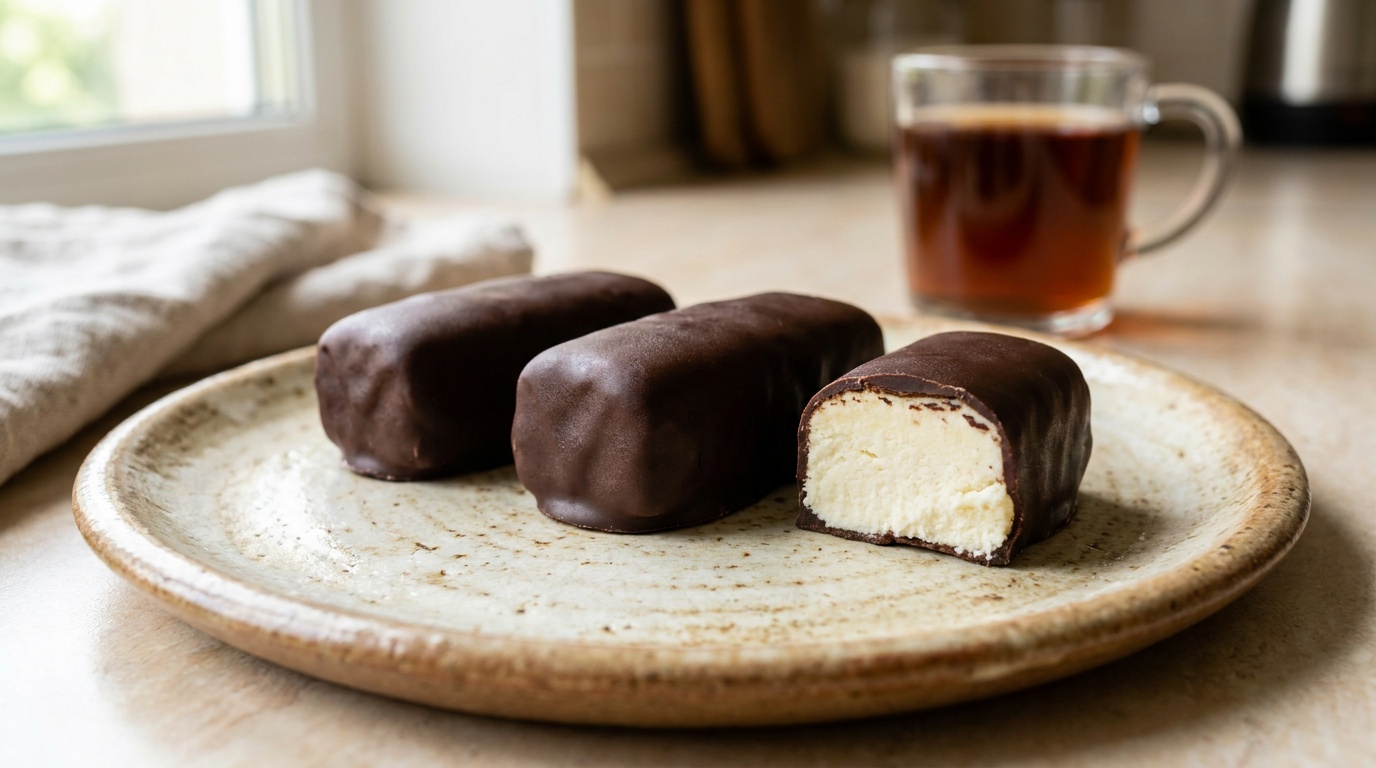
Глазированный сырок: the snack Britain is missing
Here is the item most worth smuggling into British shops. A глазированный сырок (glazirovanny syrok) is a small bar or cake of sweetened tvorog, usually covered in a chocolate or cocoa-based glaze and sold chilled in a bright foil wrapper. Vanilla, condensed milk, poppy seed, sometimes a jam centre. The Russian standard that governs them permits cylindrical, rectangular, spherical and other shapes, so the familiar rectangle is convention rather than rule.
They cost very little, they're widely sold in Russian supermarkets and convenience shops, and they're particularly associated with children's snacks and quick breakfasts. It's roughly the niche a chocolate bar fills in a British lunchbox, except it's fundamentally dairy — a small, cold, faintly tangy thing. They are little known here outside Britain's Eastern European communities and specialist food shops, where you can in fact buy them.
The grammar is worth a moment too. Сырок began as a diminutive form of сыр. Russian leans heavily on suffixes such as -ок, -ик and -очк-/-ечк- to suggest smallness, affection, familiarity — and sometimes irony or mild contempt, depending entirely on the word and the context. In сырок the form has also become simply the ordinary name of the product. Learning to read those suffixes for tone rather than size is one of the genuine turning points in sounding natural.
Столовая: the canteen
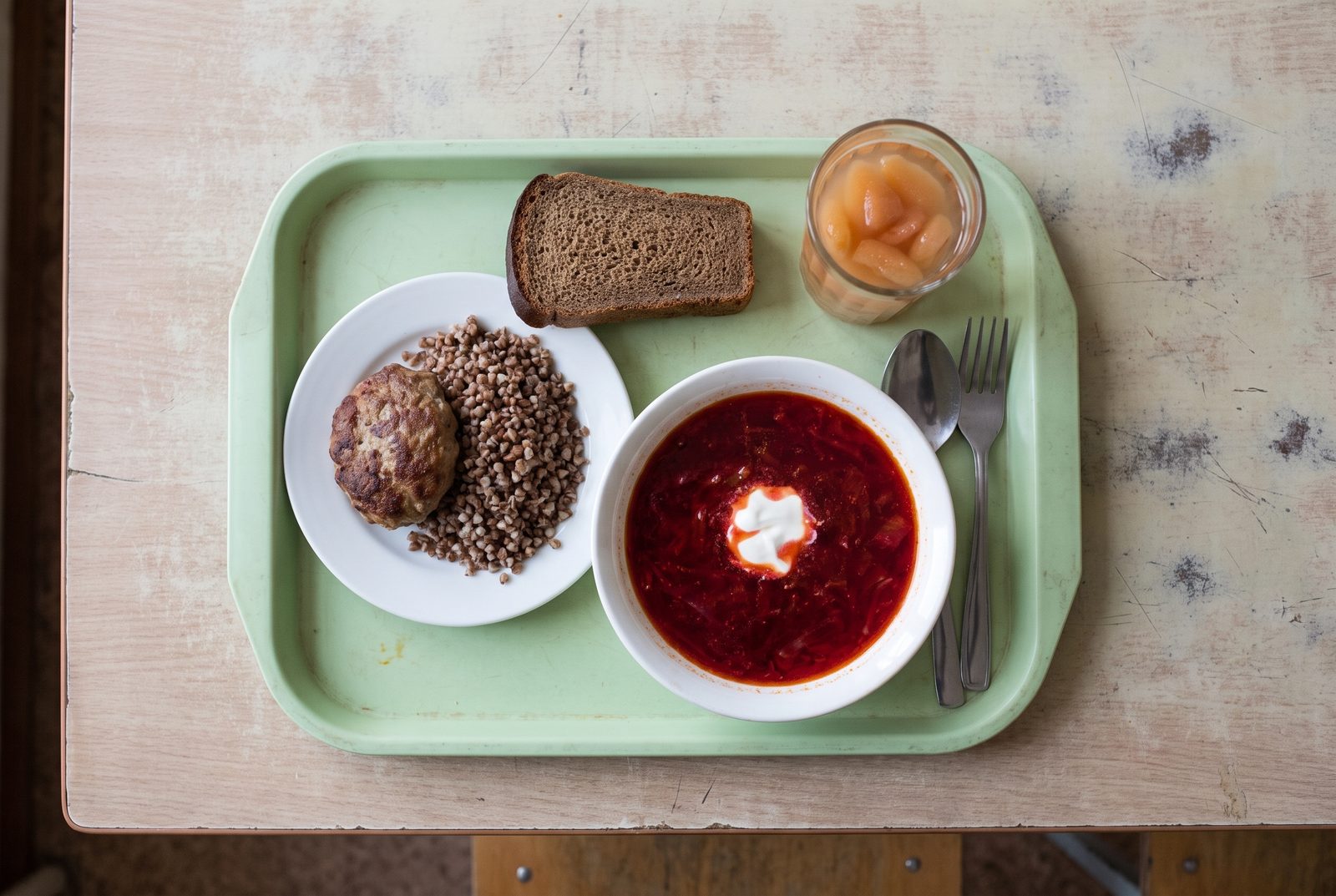
Most Russian schools and many universities have a столовая — a canteen, and a distinctly institutional one — or some other form of organised catering service. You take a tray, move along the counter, and point. It's cheap, it's substantial, and it runs on a fairly predictable rotation:
- Суп — soup, and typically a proper first course (первое) rather than a starter. Борщ (beetroot), щи (cabbage) or солянка (sharp and salty).
- Второе — literally "the second", meaning the main: a cutlet, meatballs or chicken with a side of buckwheat, potato or pasta.
- Гарнир — the side. Гречка (buckwheat) is extremely common and worth acquiring a taste for.
- Компот — a drink of fruit stewed in water, served cold, at room temperature or occasionally warm. Every Russian adult has a view on canteen kompot, usually nostalgic.
- Булочка — a sweet or plain bun, theoretically bought as an afterthought and, in practice, very often eaten first.
The one phrase to have ready at the counter is Мне, пожалуйста… — literally "For me, please…", though the natural English equivalent is "I'll have…, please" — followed by whatever you're pointing at. It's the workhorse of Russian ordering: polite, brief, and it works in a canteen, a bakery or a café.
Six phrases for a Moscow café
Moscow's coffee scene is genuinely excellent, and staff will often switch to English the moment they detect an accent. If you'd rather they didn't, these six will hold the line:
- Здравствуйте! — Hello (formal). Worth saying: Russians tend to notice a greeting rather more than British customers expect.
- Мне, пожалуйста, капучино. — I'll have a cappuccino, please.
- С собой или здесь? — "Takeaway or here?" You'll be asked this. Answer: с собой or здесь.
- Что вы посоветуете? — What do you recommend? The single best phrase in any language for turning a transaction into a conversation.
- Можно счёт, пожалуйста? — May I have the bill, please?
- Очень вкусно, спасибо! — Very tasty, thank you. Deploy generously.
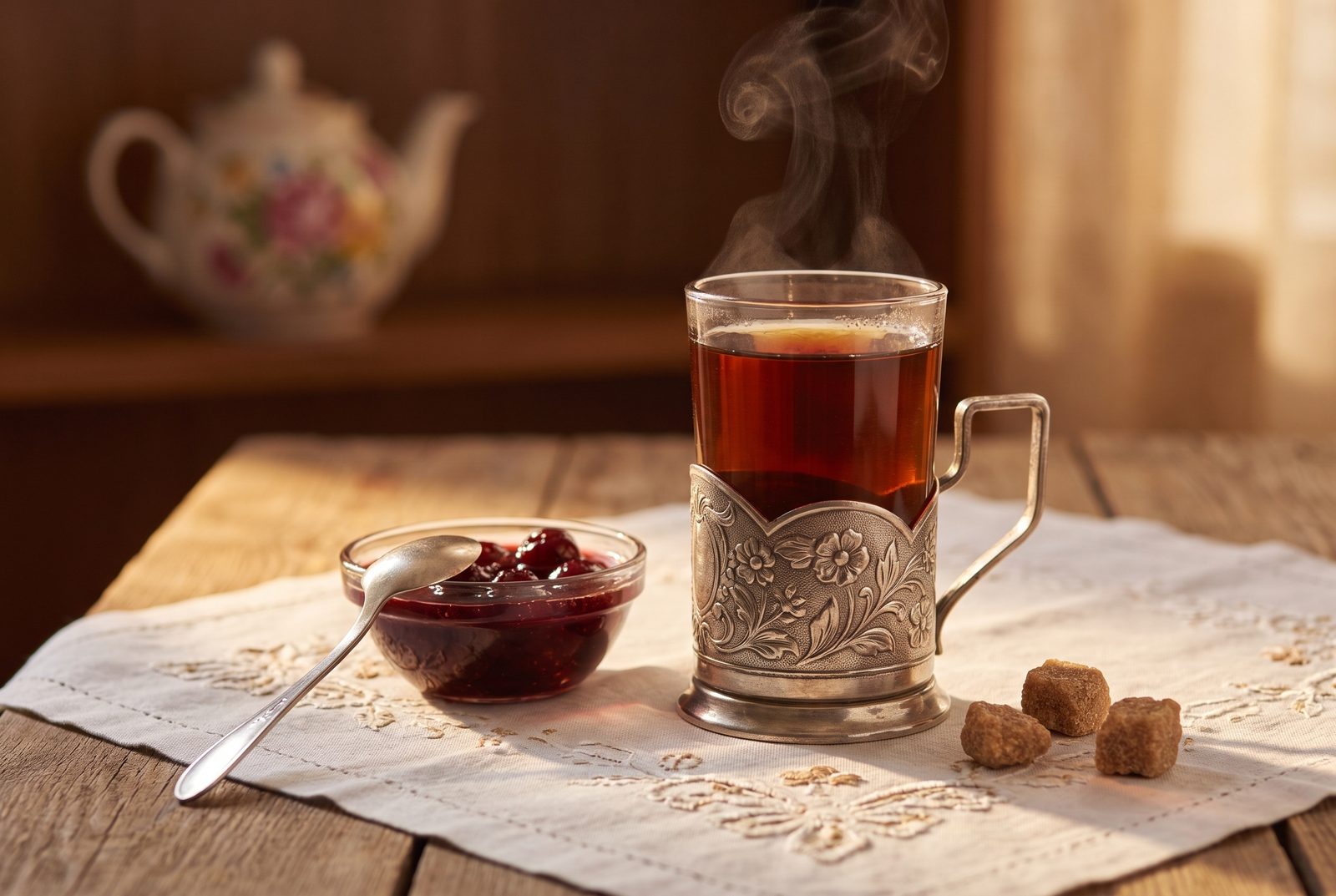
And one piece of tea etiquette worth knowing, with a caveat. In traditional Russian home or samovar-style tea service, чай may be accompanied by варенье — a whole-fruit preserve served in a small dish. It can be eaten by the spoonful between sips, spread on bread or pastries, or stirred in to sweeten the tea. Accepting it graciously in someone's home will earn you more goodwill than a grammatically perfect sentence. Do not, however, assume an ordinary Moscow café will bring it automatically — that's the preserve of traditional restaurants, themed places and Russian hospitality rather than the chain on the corner.
Why food vocabulary punches above its weight
Because it's used, and used, and used again. Grammar learned in the abstract fades. Grammar attached to a plate does not.
It also happens to be examinable. Food and daily life are explicit GCSE topics — they sit under "Daily life" in the Edexcel GCSE Russian specification — and they can provide useful cultural material at A-level too, particularly in speaking, in independent research and in broader discussion of Russian society. Worth being precise here, though: the A-level themes themselves are social change, political and artistic culture, a major Russian city and the final years of the USSR. Food isn't a named theme; it's a way into several of them. Either way, a candidate who can talk about syrniki with genuine knowledge — what's in them, what you put on top, that they're named after cheese but aren't made of it — is generally far more convincing than one reciting memorised vocabulary.
A suggestion, for what it's worth: pick one Russian dish this month and learn to cook it in Russian. Find the recipe in Cyrillic. Work out смешать — to mix, обжарить — to fry or brown, and добавить — to add. You'll finish with about fifteen new words, useful practice at following Russian instructions, and breakfast. Note that some recipes give the steps as infinitives like those, while others address you directly with imperatives: смешайте, обжарьте, добавьте. Learning to recognise both is half the battle with any Russian recipe.
Start with syrniki. They're forgiving, and everybody likes them.
Sources & further reading
Food writing attracts more confident nonsense than almost any other subject, so the language, the product definitions and the exam claims here are checked against named sources.
- Gramota.ru — dictionary entries for творог (both stress patterns), сырник and сырок, and the imperative forms смешайте / обжарьте / добавьте
- GOST 33927-2016 — Сырки творожные глазированные. Общие технические условия, the Russian standard for glazed curd bars: permitted glaze, and the cylindrical, rectangular, spherical and other shapes allowed
- Pearson Edexcel GCSE Russian specification — food and drink under the “Daily life” theme
- Pearson Edexcel A-level Russian specification — the four themes, confirming that food is not among them but can serve as cultural and research material
- Russian-language reference on Russian tea tradition — samovar service, the role of варенье and the подстаканник
Last fact-checked: August 2026, after review by a native speaker. Spotted something wrong? Do tell us — we would rather know.
Want to learn real conversational Russian?
Book a private tuition session with Marina — a native speaker with 25+ years' experience, teaching the Russian people actually use at the counter, the table and the till.
Book a Private Session with MarinaOnline via Zoom, Teams or Google Meet · Face-to-face in Bromley